Tuesday, 30 May 2017

The Secret to Filming an Awesome Remote Interview

How to film remote interviewsFilming video interviews with popular influencers in your industry is a great way to stand out as a thought leader; however, as we’ve learned here at Vidyard with our own remote interviews over the years, sometimes you line up a terrific interview, but your interviewee is too far away for a convenient in-person shoot.

*note: we have not been able to get Oprah on the line…(yet).

When dealing with the remote-interview-challenge, you could book flights for your video crew, outsource remote production, or even get interviewees to shoot their response footage on a webcam for later mashup with home-base footage, but some of these options are costly and you don’t necessarily want to lose a spontaneous back-and-forth interview feel by arranging pre-taped footage. Alternatively, you could record a Skype split screen, but this can be a bit boring to watch.

The remote interview is certainly tricky, but I think the folks at Quarry Integrated Communications have found a clever solution.

A Great Remote Interview: AQ’s Blog & Grill

Quarry Integrated Communications, winner of Marketing Profs’ B2B Agency of the Year Award, produces a great series called AQ’s Blog and Grill; a video blog showcasing industry thought leaders with an emphasis on branding and entrepreneurship.

With video services provided by Skylight Productions, the series has a very professional look and feel and they’ve scored high-profile guests from Gary Vaynerchuk to Guy Kawasaki.

Not every interview is remote but Grillmaster, Alan Quarry, certainly doesn’t let distance get in the way of a great interviewee. A great example is his chat with everyone’s favorite Marketing Prof:

How AQ’s Blog & Grill Gets it Right

This interview seems to borrow its approach from television and, if you’re up for it, you can incorporate some of the following techniques from the Grill in your own videos:

A strong, concise intro

After a quick series intro featuring the blog’s logo, Alan Quarry gives a succinct welcome to his guest. A lot of YouTube stars and B2B marketers seem to take forever to get into the meat of their videos, but this 18 second intro is clear and it’s all the video really needs to get viewers on board. Remember, if your audience has clicked through based on your splash screen, they’re interested, so give ’em the content already!

The interview is visually compelling

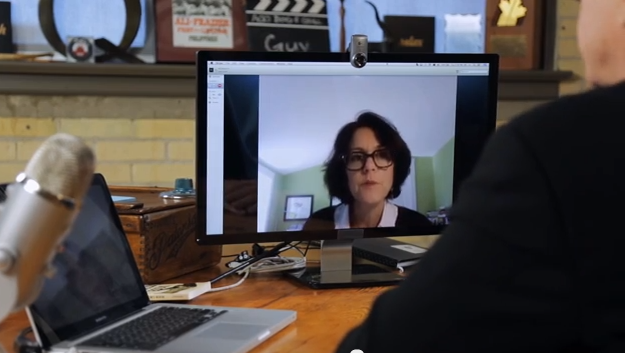
In this case, the visual style is the trick to perfecting the remote webcam interview. Although Ann is not able to be on location, the editor didn’t just intercut footage of the participants’ computer screens. The video includes establishing shots of the office, clever over the shoulder shots of the host interacting with the guest, and there’s even some subtle effects to keep your attention.

For example, the camera is on a slider, so there’s some dynamic movement to the over the shoulder shot (check out 0:38 to see this slide motion in effect). Overall, the interview holds your attention because you’re not just watching direct, head-on shots of two people for ten minutes.

You’re watching an interesting webcam conversation that maintains its visual appeal by mixing things up at an appropriate pace.

There are no distracting tech issues

Filming with a webcam is a great idea, but if your connection is unstable, your audio is off, or your guest freezes mid-sentence, it’s a waste of your guest’s time and you might not score another chat with them. If you take on the approach used in this video, note that it’s best to film on a retina screen because of the high refresh rate. Filming on a retina screen will eliminate the look of horizontal refresh lines running through the computer’s display and you’ll get a much clearer picture.

You’ll probably also want to ask your guest to connect to a hardwired internet connection. THe last thing you want is their footage cutting in and out during a great interview!

They’ve used great lighting and styled the look

With a beautifully lit office containing various pieces of visual interest, Alan’s desk looks natural and they’ve made a great use of what could be a plain space. The host is wearing bright blue which complements the yellow brick set, and there’s nothing distracting happening in the webcam footage. What I mean here is that there’s no glare on Ann’s iconic glasses (as you’ll sometimes see in webcam-footage interviews) and there’s no harsh shadows on Ann’s face from overhead lighting. When shooting a webcam interview, you’ll want to coach your guest to ensure they capture a flattering look. Watch out for glare on glasses, weird framing, background noise from vents at their location, and watch that they are not filming themselves in harsh lighting or in front of windows as this will make them appear as a giant shadow.

They’ve maintained spontaneity

We’ve all seen an interviewer glaze over as they ask their pre-written question in a robotic voice and then drift off as they wait for a reply from their guest and, frankly, there’s no quicker way to lose your audience. In this video, however, you’ll notice that even if Alan Quarry has planned questions for Ann, his delivery is natural, and he actively listens and responds to his guest in an engaging way. Whether it’s a webinar or a recorded interview, you’ll want to treat your video interview like live TV. That is to say, don’t look around while your guest is speaking, stay present, and engage. If your host is interested, the audience will stay with you.

Overall, because content marketers are aiming to emulate media companies, it’s fitting that your interviews mimic television. There’s no need to reinvent the wheel, but you’re dealing with online tools so you’ll have to be savvy. Try out the Quarry interview technique and give your intercut shots some visual interest, especially when you’re filming a remote guest’s computer screen.

3 Other Remote Interview Examples

For a few other great examples, check out some of our top picks below. Note that the first two require a little lower production value and can be re-created without your own camera crew!

1. A simple shared screen example with Seth Godin

This is great when the star of your interview is a real thought leader, but staring at one person’s face even when they’re not the one asking the questions can sometimes feel a little awkward.

2. A split screen from AppSumo

The split screen can be accomplished through a tool like Skype, which also lets you record your session as it’s happening with no additional screen recording software required. AppSumo uses this approach for expert interviews.

3. A switch between big screen and live stream with Ben Mulroney

The TV show, “Your Morning” recently interviewed the first woman to walk the full Trans-Canada trail and they did so through a video call. Check out how they cut the footage in post-production to include her livestream in the room with host, Ben Mulroney, and a cleaner cut of her for viewers at home.

If you’ve seen any other examples of great marketing interviews, leave us a link in the comments section and tell us what you liked best about them.

The post The Secret to Filming an Awesome Remote Interview appeared first on Vidyard.


source http://www.vidyard.com/blog/the-secret-to-filming-remote-interviews/

Thursday, 25 May 2017

3 Reasons Why Video is Ideal for Internal Communications

Marketers have long understood the advantages of video: it’s multi-media, it’s exciting, and it conveys a lot of information. According to Hubspot, 87% of marketers use it and according to Google, 50% of customers expect it. So if video is so clearly the preferred method for communicating with our customers, then why are we still doing so much emailing internally?

For many organizations, there are a variety of reasons. Video isn’t how things have traditionally been communicated and email culture has a lot of momentum. There’s also the fact that we’re all a little camera shy, and that recording technology up until a few years ago has been cumbersome. Yet with the emergence of simple sharing video technologies like ViewedIt, you can wipe all those excuses aside. Video is the internal comms tool of the future. Here’s why.

3 reasons why video is ideal for internal communications:


1. Video is far more effective

Video allows you to get your point across in less time. Just take this common office scenario: a new employee needs help getting set up in a software system. They ask a colleague for help, and after a few back and forth emails and screenshots, their coworker just walks over and points at their screen. Why? Because the combination of talking and showing is more effective. You can now easily perform this point-and-show maneuver through video and once created, that clip can be stored for the next person, or shared at scale from the start. Your employee isn’t just saving one walk across the room, they’re saving tens or hundreds from all the people who will be hired in the future.

Are you starting to see the possibilities? Video can speed up and streamline onboarding, weekly team updates, and peer-to-peer tribal knowledge sharing. It can disseminate information from product teams to salespeople, from salespeople to product marketing teams, and everyone in between. Even finance can get in on the action. Here at Vidyard, our finance team put an end to silly expense reports errors with a series of how-to video snippets that really showed off their sense of humor. Check out this one from Lucy as an example:

2. Video is simple and secure

Tools like ViewedIt make video even easier than email. Within a few clicks, you can record yourself, your screen, or both, and send it in email or share the link directly over a messaging platform like Slack. Research by Forrester suggests that one minute of video is worth 1.8 million words which, were you simply typing, could take quite some time. Video conveys more information with less effort.

For many organizations, video still seems daunting. For example, assuming create-your-own video tools like ViewedIt didn’t exist, how would you send a video around to your company? If you tried sending an MP4 file you’d likely find that it doesn’t fit within the 20 to 25 MB file limit for your email provider. And if you tried uploading it to YouTube and sharing the link, you’d likely have to play with the privacy settings to limit the rest of YouTube from seeing it. Plus, if you wanted to prevent Justin Bieber’s new single ‘Baby’ from auto-playing after it, you’d have to pay. At the end of this desperate journey, some poor souls have even yielded to the siren’s call of Sharepoint, but were never heard from again.

With ViewedIt, videos are stored instantly and securely, and you can track when they’re watched. Want to know which employees are engaged and see who watched the fiscal year review from your CEO? No problem.

Previously there was no simple way to create, share, and track video, but now there is, and there’s no excuse not to.  

3. Video is engaging and fun

With time, video becomes the internal communication path of least resistance. Employees find that in many situations, it’s easier to record themselves talking through a problem than to find the precise words to put into an email, and they start to have fun with it. It becomes a way to reinsert some personality into the workplace and builds bonds of fraternity. But how do you push an entire organization past their initial camera shyness? The same way you treat film: exposure.

We know this because every new employee here at Vidyard goes through it. First, they start sending videos to trusted audiences where there’s no judgement. Then, they start sending three to four bite-sized videos per day and graduate to sending to audiences of peers who can provide minor feedback. Before they know it, video is barely different from an in-person conversation, and while it’s never a replacement for face-to-face, it’s the very best next thing. So move over marketing, it’s time for internal communications to take the mic.  

The post 3 Reasons Why Video is Ideal for Internal Communications appeared first on Vidyard.


source http://www.vidyard.com/blog/why-video-ideal-internal-communications/

Wednesday, 24 May 2017

6 Mega Trends in Sales, SaaS, and Video from HubSpot’s Chief Sales Officer

Recently, Hunter Madeley, Chief Sales Officer at HubSpot, sat down with our CEO, Michael Litt to discuss all things sales, SaaS, and video! They bantered for nearly an hour by the toasty fire, but since everyone likes things short and sweet these days, we figured we’d wrap up six of the biggest takeaways.

(But hey, if you have some time, check out the full recording at the end of this post!)

1. The purpose of sales and marketing continues to be on creating credibility, momentum, and trust

Although technology has changed the way businesses communicate externally, Hunter highlights how the ultimate goal of a marketing or sales organization has remained the same. This is to create initial credibility with a prospect, begin to build momentum by demonstrating the value that your product or service can provide, and ultimately ensure that trust is built across every interaction.

2. Technology gives teams the opportunity to develop personalized relationships at scale

Hunter stresses the importance of leveraging technology to create meaningful relationships at scale, and not simply spam a large audience in hopes of garnering attention. If a marketer or a salesperson uses technology effectively, they should ultimately be creating an unparalleled customer experience that is completely tailored to the needs of that prospect.

3. Effective sales teams should be open to trying any technology that creates more emotional connections

In order to be a truly successful sales organization like Hunter’s at HubSpot, it is crucial to be open to any new technology that enables team members to create more meaningful experiences for a prospect. If you are not open to trying new things, but your competitors are, then your sales organization is starting out disadvantaged – a tough fate when competition for attention is at an all-time high.

4. Storytelling through video is incredibly powerful, especially for video natives

Rather than trying to bring a story to life through highly descriptive text, why not show it through video? Hunter stresses the importance of using video to tell truly compelling stories that can be easily digested by a prospect. His example of searching for a how-to-video to fix his Jeep, versus reading a manual, highlights the movement towards watching versus reading in our personal lives as well! Plus, for the video natives that represent a large portion of the workforce today, creating and consuming videos from smartphones or computers is second nature.

5. Marketing automation + CRM + video = a win, win, win!

In order to truly understand every interaction a prospect has with your brand, it is crucial to have technologies that pair incredibly well to provide a full funnel view. This means understanding how a prospect arrives at your website, what content interested them, which videos they found most engaging, and what actions they are looking to take next. By having a complete understanding of their lifecycle, marketing and sales teams alike can deliver personalized experiences that guide their next step. After all, every prospect deserves the ‘white glove’ treatment!

6. Sales and marketing must work together, but don’t forget about the product team!

At HubSpot, their organization has evolved from a ‘smarketing’ focused business, to a ‘sparketing’ one (as Hunter puts it!) This means that they involve sales, marketing, and product teams in company strategy planning as everyone should have an equal seat at the table. For HubSpot, they are taking a product-led approach by which users are able to ‘try it before they buy it’: similar to what a neighbourhood bakery might offer new customers. After all, marketing can create pipeline, sales can turn these into opportunities, but it is the product team that must deliver in order to convert a prospect to a happy customer.

If you found these six points valuable but feel you want more, watch the entire interview between Hunter and Michael, and learn more about:

  • How storytelling has changed since Hunter started his SaaS adventure in 1998
  • Hunter’s coffee preferences
  • The future of marketing technology and the role it will continue to play
  • How video impacts the sales cycle from a process perspective


Interested? Of course you are! Check out the full interview below.

.

.

The post 6 Mega Trends in Sales, SaaS, and Video from HubSpot’s Chief Sales Officer appeared first on Vidyard.


source http://www.vidyard.com/blog/6-trends-sales-saas-video-hubspot/

Tuesday, 23 May 2017

Chalk Talks: Using Video Analytics for Smarter Selling

One of the keys to a successful sales team today is understanding as much as you can about your prospective buyers’ interests so you can send them tailored messaging and get a relevant and timely conversation started.

My name is Terrance Kwok, and this is another episode of Vidyard Chalk Talks, and in this Chalk Talk episode, we’ll be talking about how your sales team can use video to better understand what their buyers are interested in so that they can send that tailored messaging out and get those tailored, relevant, and timely conversations started.

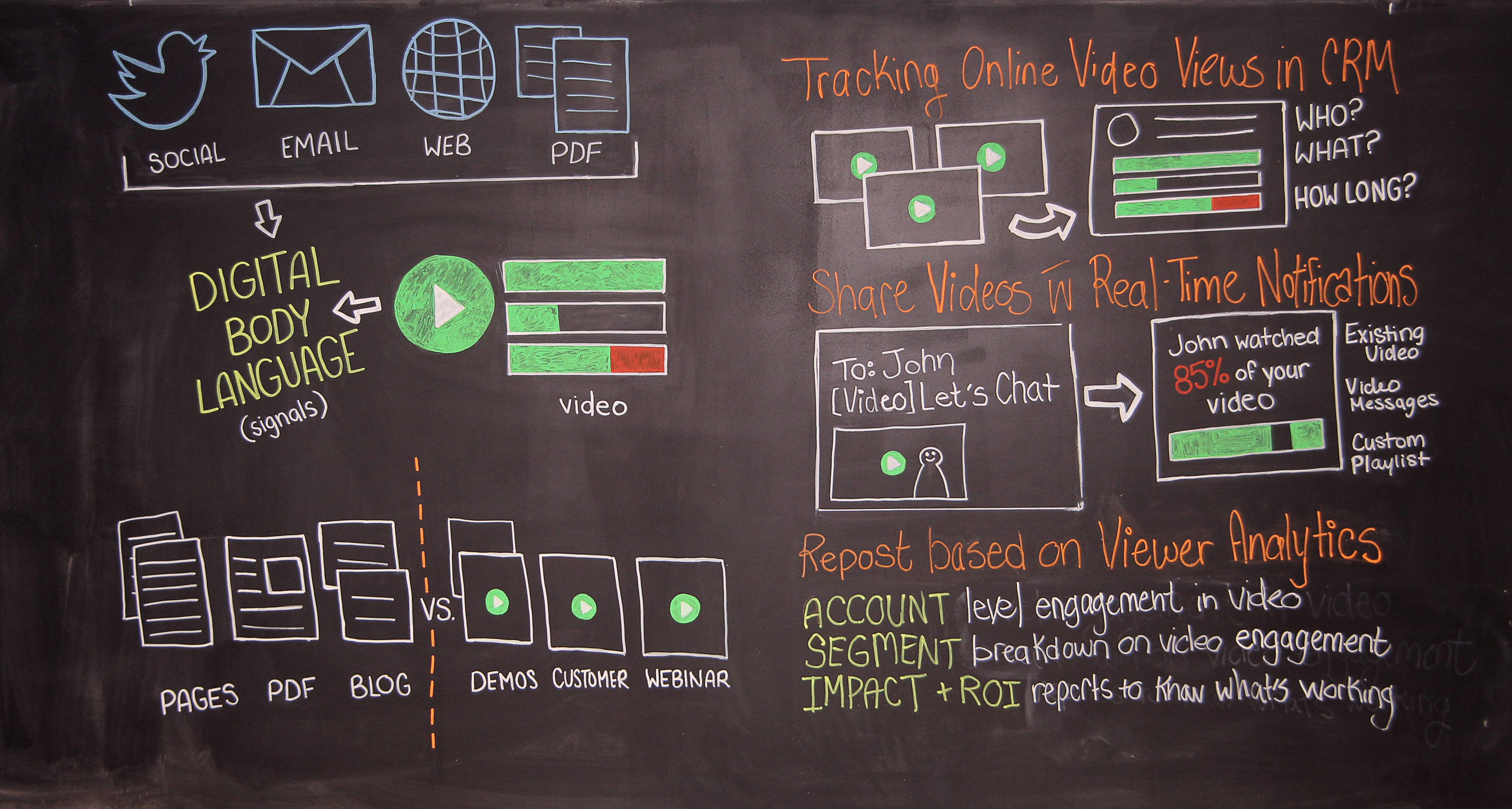
Today, your sales team is probably tracking a bunch of data. They’re looking at what prospects are posting on social, what emails are being opened and clicked on, what web pages are being viewed, and which PDFs are being downloaded. That’s fantastic. That is the digital body language of your lead. And digital body language is important, because now you can prioritize the right leads, send them the right content, at the right time.

However, most companies are actually missing a key part of digital body language, and that is video. They’re not understanding which leads are watching which videos, and for how long. And this is absolutely critical.

Take a look at these two leads as an example.

A Real Example of Why Tracking Video Matters

Say you have two leads today. The first lead comes to your website, they look at a couple web pages, they check out a PDF, they read a couple articles. That’s fantastic. Your marketing probably sent that lead over to your sales team, and your sales team was happy to give them a call.

Now take a different lead. Say this one comes to your website, they watch your product demo, they watch it again, then they watch a customer testimonial video, and then they watch a webinar. There’s a high chance that your marketing team isn’t even sending this lead to your sales team, because it looks like a lead came and looked at one page, looked at a second page, and then looked at a third page and bounced.

But you and I both know this lead actually spent like 30 minutes looking at your content, educating themselves on your products and services, and is actually way more qualified than the first one.

And that is why understanding which videos are being viewed and by who is so important.

sales video analytics

Two Top Ways to Track Video Consumption in Your Sales Process

Tracking Marketing Videos in your CRM

So how do you get started? Let’s think about the first point. What you’re going to need to do is enable your team to understand which videos are being viewed across all your digital properties. You’re going to want to understand who’s watching your videos, what they’re watching, and how long they’re watching them across your website, and across social.

When you use a tool like Vidyard, you’re actually able to automate all this and then pass this information into your marketing automation platform and CRM so that you’re effectively building a history of that lead’s viewership behavior.

And with that, your marketing team can start scoring the leads based on video views, and pass the right leads to your sales team at the right time. And when your sales team gets that lead, because that information’s exposed within your CRM, they can look at the lead, understand what they’re interested in, follow up with the right contact, and get the conversation started.

Tracking Sales Videos

The second way you can use video views in your sales process is to enable your sales team to share videos directly with customers, and then get real-time notifications when those prospects are watching those videos.

So for example, say your BDR is trying to break into a couple of accounts. They might email a bunch of personal videos to those accounts, but they’re going to want to focus on the leads that actually watch that personal video. If they get a video view notification from that lead, after they’ve watched the video, they’re going to want to pick up the phone, and prioritize that lead right away. Because that lead has shown them that their brand is top of mind, and that they’re probably at their desk.

You can also use videos in your sales process by creating playlists of custom content or existing video content.

So say, for example, your accounting executive is working a deal and it’s almost about to close. You might create content based on what they might be interested in and send it off, but with real-time notifications in a tool like ViewedIt, you can now start understanding which videos are being viewed in that playlist, which parts are being re-watched, and that way you can focus on your next sales call on relevant information that they’re most interested in.

What Should You Be Tracking?

We talked a bit about how you can track who’s watching, what they’re watching, and how long and how your sales team can use videos in the sales process to be more effective. Let’s talk about reporting. There are three reports you’re going to want to look at.

  1. The first report is understanding which accounts are viewing the most videos. That way your sales team can understand: “which accounts should I prospect and target immediately?”
  2. The second report is video views by segment. Say you sell to manufacturing, healthcare, and fintech, and fintech is super engaged with your video content, you’re probably going to want to send more videos during your fintech deal cycles.
  3. The last report is understanding which videos are impacting pipeline build and closed business. If you understand which videos actually influence the deal’s closing, what you’re able to do is now put that video front and center on your website, or even have your sales team use that video more frequently when working those deals.

My name is Terrance Kwok. This has been another Vidyard Chalk Talk. Thanks for tuning in.


The post Chalk Talks: Using Video Analytics for Smarter Selling appeared first on Vidyard.


source http://www.vidyard.com/blog/chalk-talks-video-analytics-selling/

Friday, 19 May 2017

The #1 Sales Tool I Wish I Had

Back in my day, we didn’t have tools like this. Never mind that “back in my day” was only two years ago—technological innovation moves like lightning. Back then, as an account executive at a major marketing software company, I was limited to a well-defined set of tools: email, phone, social media, video conferencing, text, and in the event of an end-of-quarter emergency, fresh-baked cookies. But the tool that I wish I had? Video.

This thought struck me during a presentation by Terence Kwok, Sales Development Manager at Vidyard, at their Fast Forward virtual conference this year (If you missed it, you can still log-in to watch the session, and you really should.) Kwok showcased the awesome simplicity with which sales reps can prospect with video. I won’t lie, it made me jealous.

Here’s why.

Video sells better

Cold calling and email are like fighting with one hand tied behind your back. I know that because I started my career in outside sales with the privilege of face-to-face meetings. The further away I got from prospects, the harder it was to persuade them. When I switched to inside sales, I lost the ability to communicate non-verbally. When cold-calling grew less effective and I switched mostly to email, I lost my voice. As far as my prospects could tell, I basically evolved into a faceless text-bot.

I mean, how different can you really be when you type in Arial font just like everyone else?

Selling Software

With video, salespeople get all that back. The smile, the sound, the motion—it’s the next best thing to a crisp handshake. “It’s a great way to let your personality shine,” Kwok told audiences, adding, “Inside sales professionals can hide behind the phone but when you’re recording videos, you sit up tall, you’re cognizant, you’re excited, you’re enthusiastic about what you’re selling … and your prospect or customer can feel it.” As a former seller, there is zero doubt in my mind that this works, because it recently worked on me.

Sales videos are still new and exciting

I recently saw a sales video in my email and clicked just to see what it was. It came from an unfamiliar company but the brightly colored thumbnail caught my eye. A young woman was holding a sign with my first name on it. We’ll call her Jordan.

Puzzled, I wondered if their sales team had built an entire library of video thumbnails with common first names, like those personalized toy license plates you find in gas stations. Could this be the case? The video played and the experience was surreal. Jordan was a real person who had done real homework and told me what my company was missing. She wasn’t totally spot on, but I was still impressed.

This personalization was no accident. As Kwok explained in his presentation, video allows salespeople to break down traditional barriers. In this case, Jordan broke the pattern of poorly-personalized sales prospecting emails that I typically receive and replaced it with something so puzzling in my inbox that I had to investigate. Never mind my interest in their product—the approach is what got me. I can only imagine how much time it would have saved me as a sales rep to stand out like Jordan did. And time savings, according to Kwok, is a big component.

Video lets you share your candid thoughts

Video lets you cut out weeks of unnecessary back and forth. I know that because in my former sales role, I used to get caught in the “if I see value” loop quite a lot. That’s the catch-22 when clients won’t talk to you until they know it’s worth their while, but they can’t know if it’s worth their while until they talk to you. See how things can get stuck? And what’s worse, as a sales rep, you can only convey so much via email or phone before they stop reading or hang up. But with video? Video lets you convey it all.

“With an account-based video, what you want to do is walk them through your thought process,” said Kwok during his presentation. He demonstrates a sample video of himself where he’s recording both himself and his computer screen as he browses through articles. He explains to his client why it’s a good idea to talk, what he presumes are their pain points, and possible solutions. And because he tells them the exact time commitment up front in the email (90 seconds), they stick around.

How brilliant is that? Rather than simply summarize the benefits, he gets to walk his viewers through the steps that led him to think that they were a good fit. It’s collaborative. It’s consultative. And it would have been killer for me to have back in my day.

The post The #1 Sales Tool I Wish I Had appeared first on Vidyard.


source http://www.vidyard.com/blog/top-sales-tool-wish/

Thursday, 18 May 2017

Chalk Talks: Generate More Leads with Video

Online video content has become the best way to tell your story, but it’s also become the most effective way to generate new leads and to qualify your prospects. My name is Tyler Lessard, and in this Chalk Talk, we’ll explore how you can use video across your marketing programs to generate more leads and to accelerate your prospects through the buyer’s journey faster than ever:

When it comes to generating new leads, there are three different steps that you need to think about. The first is attracting audiences into your website and into your digital properties. The second is once they’ve come inbound, identifying those leads and offering them something that they’re willing to give up their information for, and finally, once they’re a known, identified lead, is nurturing and educating them to get them ready to be handed off to sales. So let’s look at how video can help you in each one of these stages of the lead generation life cycle, to generate better results for your demand gen programs.

Turning Viewers into Prospects

First, let’s talk about attracting new prospects. There are lots of different ways in which video can help you drive more inbound traffic to your website. First and foremost is using video across your site to drive better SEO results. Search engine optimization is so key for all of us marketers, and with video, you can rank better with Google as well as use all that rich information within your videos as part of your metadata and use your keywords within your pages to generate more inbound traffic on the topics you’re talking about.

Pages with videos tend to convert higher from an SEO perspective than pages without, and Google prefers them and will rank them higher because of that video content. You can also use video as part of your online advertising strategy, whether that be YouTube pre-roll ads, advertisements on Facebook and Twitter or through display and banner ads. Video ads, again, tend to convert higher than do static images, and can be used effectively in both B-to-C and B-to-B marketing.

The secondary is social and using video on your Facebook, Twitter, and social channels to get the eyeballs, get people leaning in, and then to convert them back onto your site, where you can identify and work them through the cycles, and finally, is using video as part of your outbound sales methodology. Are your sales reps doing outbound cold calling? Are they connecting with people on LinkedIn to prospect and see if they’re interested in?

Video can be a great way to get their attention, and again, get them into your funnel. So lots of different ways in which you can use video to attract more people in and get them interested in your content.

Now, let’s move to the next step, which is perhaps the most important, is identifying who those anonymous people are. Once they’re on your site, there’s lots of different ways you can use video to help identify those audiences. The first is using video to drive action on a supporting call to action, so for example, I’ve got a landing page here and I’ve got this button down here that I really want somebody to click. It might be to download a certain resource or it might be to sign up for a demo. A page with a video on it that’s introducing the topic and building a more emotional connection with the viewer tends to convert higher than landing pages without video, so think about how you can use video to complement or support pages with existing calls to action.

The second is actually bringing the call to action right inside your video. With today’s technology, you can add buttons, you can add custom calls to action, you can add annotations right into the videos themselves that are clickable and actionable by the viewer, so imagine watching a video and part way through, you see a little annotation come up that prompts you to go and watch another customer story or to request the demo or to sign up for a newsletter. Those things are all possible now, and it’s a great way to engage your viewers and to convert them from an unknown audience member into a known lead, and finally, is actually embedding lead forms right inside the video, so instead of sending somebody off from this button to go and do something where they might convert, it’s bringing that transaction right into the video.

Again, imagine watching a video and at the end, it flips into a form that prompts you to then submit your information to request a demo or to sign up for a webinar or something like that. Give somebody an offer in that video frame and you’ll see a higher conversion rate than having it elsewhere.

The nice thing about embedding data collection forms in your videos as well is that it follows the video around, so when that’s embedded on your social sites, on third party sites, people can still interact with that and get right into your lead funnel, so that’s now possible with today’s technology.

Nurturing Your New Video Leads

Now, the next piece is actually nurturing those leads to make sure that they’re ready for sales engagement, and with video, there’s lots of ways to warm people up, educate them and move them through the buyer’s journey, to make them a truly qualified lead for sales. First is your email nurtures. So somebody’s come to your site, they fill out a form to do something. You’re now nurturing them with emails. Think about using video content within those email nurtures to drive higher click through rates and higher engagement and ultimately create better educated customers. We find things like customer story videos to work really well in email nurtures, as well as product explainers, thought leadership videos and interviewers with influencers in your market.

The second, then, is if you have a sales team who are now following up with those leads to test them out, to see if they’re warm enough to engage. Try using personal video messages as part of that outreach. We again find that sales reps who use personal video messages to reach out as opposed to text-based emails have a five to seven times increase in their response rates because it’s personal, it’s human and it’s much more engaging.

And finally, as your audience members are engaging in all of this video content, wouldn’t it be nice if you knew exactly what they watched and could use that information to figure out when they’re right to flip to sales? Well, that’s exactly what you can do with video analytics. With video analytics, you can track, in this case, John has watched explainer video X all the way to the end, explainer video Y only 10% of the way through, and this customer story, he watched all the way and he watched this end part more than once.

What a sales rep can now glean from this is that John is most interested in product X and there was something very interesting in this customer story that resonated with them. Now, I know this person is ready to be flipped to sales because of their engagement of the video content and my sales rep can have a much better conversation because they have the insights they need to make it personal and relevant.

When you put all this together, you can start to use video to attract more audiences into your properties, to convert them into known leads faster, and nurture them through the buyer’s journey and make them sales ready in no time. My name is Tyler Lessard and this has been a Vidyard Chalk Talk.

The post Chalk Talks: Generate More Leads with Video appeared first on Vidyard.


source http://www.vidyard.com/blog/chalk-talks-generate-leads-video/

Tuesday, 16 May 2017

Chalk Talks: Personalizing Video for Your Sales Outreach

Salespeople need every advantage they can get. In a world where your prospects are being bombarded by emails, cold calls, and social outreach, personalization and engagement are the new currencies. And smart salespeople know that video isn’t just engaging – it’s also one of the easiest ways you can add personalization to your sales cadence.

My name is Terrance. I’m a Sales Development Manager here at Vidyard! In this Chalk Talk episode, we’ll talk about the state of prospecting today and how video – specifically, personal video – is going to enable your sales team to get into more sales conversations and ultimately build more pipeline for your organization. Check it out:

As a Sales Development Manager leading a team of outbound reps, I know it’s harder than ever to get ahold of our prospects over email, and that’s because they’re receiving a hundred emails from a hundred different sales reps every single day. Not only that, when we give them a call on the phone during business hours, they’re not very likely to pick up.

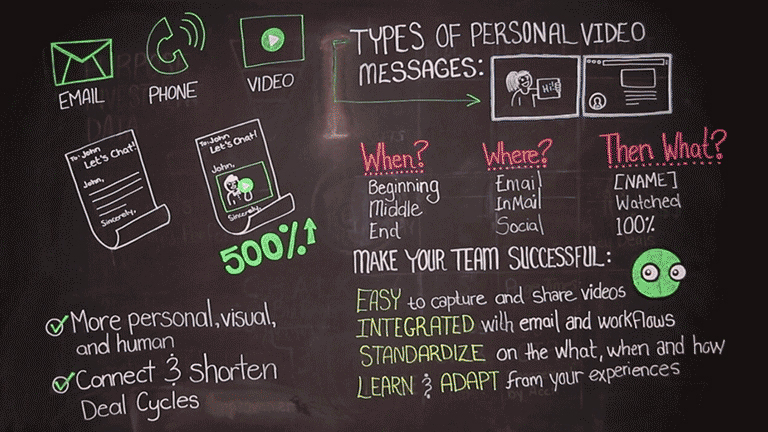
What we found was, by including video into our sales cadence, we were able to interrupt that pattern of the same, old, boring email template. Instead, we showed our prospects that we made video content specifically for them, personalized our outreach, and thus increasing our response rates by 500%.

Put the Person Back in Salesperson

What’s happening here is that video is enabling your sales team to be more personal, more visual, and humanize your team. So, when they reach out to their prospects, they know that they’re human and they’re not sending automated emails out.

By standing in front of the camera and talking directly to them, you’re showing a little bit of vulnerability, but you’re also building familiarity, so when you pick up the phone and give them a call, they know who you are and why you’re calling. Ultimately, what video’s going to do for your sales team is help them connect faster with their prospects and shorten those deal cycles to be more efficient. So, how can you get started with personal video today?

Easy Videos for Quick Wins

There are two types of videos you can use in your sales cadence. The first video is a webcam video. This is basically leaving a little message in your prospect’s inbox, on-camera, explaining to them your value proposition, your message, and why you should book the next step. When you do these webcam videos, make sure you grab a whiteboard.

Write their name on the whiteboard so they know the video is meant specifically for them. By doing so, you’re going to increase the click-through rate of your video and thus have more prospects actually hear your message!

The second video is a screen capture video. The screen capture video is great because it enables you to connect the dots between all that research you did before targeting this account or this prospect and visualize that specifically for them. So, for example, say you found a great article that was written about the company. Walk them through your thoughts about that article and explain why the contents of that article make them a good potential customer. That’s it!

Terrance Chalk Talk Blackboard

With these two videos, you can include them in your 10-12-touch sales cadence. What I recommend is you don’t use video on every single step but instead scatter it across your cadence at the beginning, middle, and end. Somewhere at the beginning, you’re going to want to start with a webcam video. Why this is important is that webcam video introduces yourself to the prospect, shows them that you’re human and that you’re not automating your emails. Because you’re including a video at the beginning of your cadence, you’re much more likely to get a response, therefore saving yourself time, instead of having to run through the entire cadence.

The second place you’re going to want to use video is somewhere near the middle. At the middle of the cadence, use a screen capture video and focus specifically on your prospect. Talk them through why they are a good person for you to be connecting with. What I recommend is record their LinkedIn profile and explain to them why their title, role, and experiences make them a good prospective customer.

At the end of your cadence, instead of sending that same boring stripline stuck under a rock, eaten by an alligator, blah, blah, blah, blah, blah, email, actually leave your prospect with some value! Include another screen capture video, but this time, walk them through three things that they should take away from this sales cadence. That way in the future, when the timing is right, they can then refer back to that screen capture video, understand why you were reaching out, and then start the conversation when the timing is better.

We talked a lot about video in email, but you can also use video in your InMails or on social channels, like Twitter. What’s important here is that video does not replace these communication channels. Instead, it enhances it. So instead of getting rid of all your InMails, make sure you’re adding video to the InMail to create a better experience for your prospect.

And last but not least, after you’ve sent all these videos out and you get notified that someone’s watched your video, what do you do? At this point, when you get notified that someone’s viewed your video, pick up the phone and make the call. Strike when the iron’s hottest! You’re going to want to call them then and there because they’re likely at their desk and the video is top of mind, which makes it a lot easier to get the conversation started.

Getting Your Team Ramped Up with Video

So far we’ve talked about:

  • The types of videos you can use
  • When you can use them in your cadence
  • Where to use them in your cadence
  • And what to do after they viewed it

So, how do we actually get your sales team started? First, you’re going to want to select a video creation tool that is easy to use and integrated with your existing workflows. With ViewedIt, you can create, send, and track video content directly within your email platform as well as your existing sales cadence management tools and CRM. After you enable your team with ViewedIt, you’re going to want to have them practice, and they’re going to need to practice!

Once they’ve practiced and they are more comfortable with video, start thinking where you can standardize video in your sales cadence. By standardizing video in your sales cadence, you’re building a repeatable process that you can then reiterate on in the future, and I think there’s a lot to be said about reiteration.

Have your sales team think about video as another tool that they’re going to need to practice and perfect, that way they can continue to learn and adapt from their experiences. Just like cold calling, it’s pretty hard when you start off, but through a bunch of coaching, role-playing, and actual cold calling experience, they’re going to get better at cold calling, and it’s the same thing with video. You’re going to want them to start by sending video internally, get comfortable on camera, then start sending videos out to the prospects, and ultimately reviewing the videos that they sent out to their prospects and seeing where they can improve.

Thank you so much for tuning in for another Vidyard Chalk Talk. See you at the next one!

The post Chalk Talks: Personalizing Video for Your Sales Outreach appeared first on Vidyard.


source http://www.vidyard.com/blog/chalk-talks-personalizing-video-sales-outreach/